
Mid-Week Intermission Artist Edition: Emily Eisenhart, Contemporary Artist
At the Long Center, we’re always looking for new ways we can engage in Austin’s creativity and bring that to our community. In such an artistic, energetic, and inspired city, there’s always something new to be discovered, and we want to help folks seek that out.
You might have heard us mention a thing or two about Long Center Collective. This is our reimagined patron membership program that seeks to do just that – connect the curious with the brightest corners of Austin’s creative spirit. Through curated events and intimate gatherings, we’re building a community of engaged supporters who are connected to the city’s vibrant arts scene.
So, with the Long Center Collective’s next event coming up this May, we thought it would be a great time to chat with one of the creatives at the heart of the experience, Emily Eisenhart. A muralist, sculptor, and mixed media artist with a passion for ethnography, Emily’s work focuses on using art to connect people with their environments.
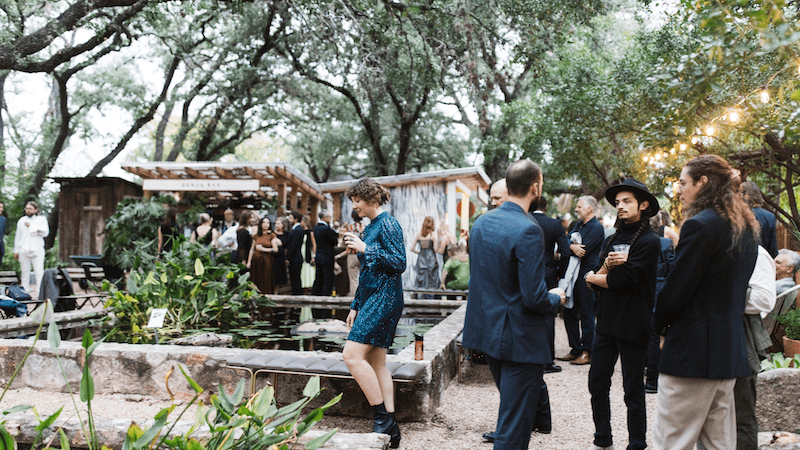
Read on to learn more about Emily and get a sneak peek of what you can expect from her and landscape designer Amy Hovis’ immersive installations specially designed for the LC Collective’s Spring Garden Party at Barton Springs Nursery on May 7.
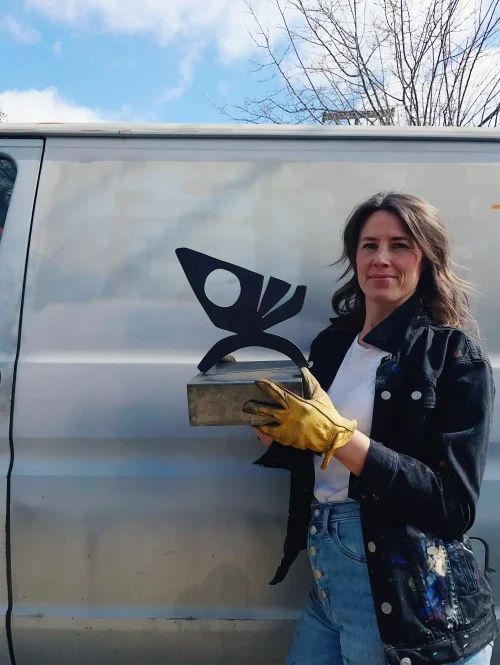
Welcome to Mid-Week Intermission! We usually like to ask folks for a song to go with their interview — anything come to mind?
EMILY: “Somewhere Over the Rainbow” (Israel Kamakawiwo’ole’s cover) comes to mind. It’s perhaps a more somber answer than expected, but it feels like the most truthful one. I lost my dad this past August and welcomed my first child in January, so it’s been a deeply transitional, bittersweet time. As a creative person, that shift has really transformed how I make. There’s more reflection, more tenderness, and a different sense of time in the work. That song holds both grief and hope in a way that feels very true to where I am right now.
Tell us a bit about you! How did you get your start as an artist in Austin?
EMILY: I’m in my eleventh year in Austin…my, how time flies! I moved here from San Francisco in 2015 seeking a city that felt creative, collaborative, and like a living canvas for artistic exploration. When I first arrived, I really immersed myself in the community. I met as many people as I could, attended events, and started saying yes to artistic opportunities. Murals were my entry point, and over time that work naturally expanded into sculpture, large-scale installations, and creative consulting and producing.
My background is actually in the design world. I spent years working at IDEO, a firm that pioneered human-centered design, which deeply shaped how I approach my art practice. Additionally, I draw from my background in Cultural Anthropology to understand place, community, and story before creating anything.
Today, through my creative studio, Studio Eisenhart, I collaborate closely with architects, developers, and designers who are actively shaping Austin’s built environment. More and more, I’m exploring large-scale, site-specific installations in the public realm – plazas, courtyards, parks – spaces where people gather and move through daily. I’m especially interested in infusing a sense of play into that work, for all ages, and creating moments that invite curiosity, interaction, and connection. Austin has been an incredible place to grow my practice. It rewards experimentation and community, and I feel lucky to be part of that ecosystem.

Your work focuses on the relationship between art and the natural and constructed environments around us. What inspired you to explore this dynamic, and contribute your creativity to it?
EMILY: Nature has been my greatest teacher and deepest source of inspiration since childhood. I’ve always been drawn to the way light moves through trees, the textures of natural materials, and the quiet intelligence of ecosystems. Moving to Austin really amplified that awareness. Here, there’s this constant interplay between rapid urban development and deeply rooted natural systems. That tension (and harmony) became something I had to keep exploring. In a way, my work is a dialogue: how structures can echo organic forms, how art can soften or reframe built environments, and how we can create moments of pause, curiosity, and play within spaces. I approach each project like an ethnographer – studying the site, its history, and its community – so the work feels grounded and responsive. At its core, my practice is about reminding people that even in constructed environments, we’re still part of a larger ecosystem. I aim to create opportunities for people to feel that connection in a tangible, immediate way and with awe.
We’re so excited to experience the immersive work that you and Amy created for this event. Can you give us a brief overview of what to expect?
EMILY: The installation is designed as a series, which can be experienced collectively or as individual focal points. We’ve integrated sculptural elements with plant life in a way that blurs the line between what’s natural and what’s fabricated. There’s a strong emphasis on texture, movement, and light – pieces that shift depending on where you stand or the time of day. Ultimately, we want people to feel like they’ve stepped into a space that’s both intentional and alive, where art and environment are in conversation with each other. More than anything, we hope the sculptures inspire people to slow down, notice, and contemplate their surroundings in a new way.
Can you share a bit about the collaboration process between you and Amy?
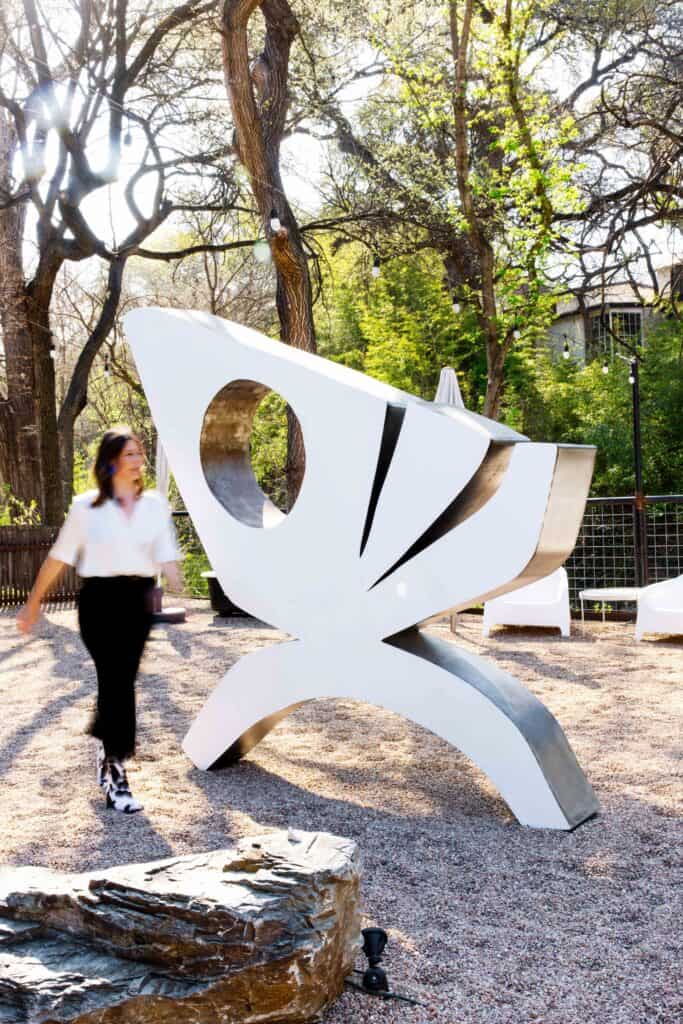
EMILY: Amy and I met through the design community here in Austin. We hit it off immediately given our shared love of art and plants. We both contributed to the venue design for 2024’s Austin Home & Design Awards and have been angling to collaborate since then. Last year, we introduced a large sculpture to the Barton Springs Nursery grounds – a cascading steel piece, Cascade, that greets patrons when they arrive. It’s become a beloved landmark, and since then we’ve been dreaming up how to expand that dialogue across the landscape. We’re both really committed to site-specific design, so the process has been very iterative – walking the grounds, identifying moments of opportunity, and pairing sculptural interventions with plant selections that enhance and respond to each other.
Why do you think Barton Springs Nursery is a fitting venue for this Collective experience?
EMILY: Barton Springs Nursery already embodies the kind of relationship we’re interested in exploring – it’s a cultivated space that still feels wild, immersive, and deeply connected to its environment. It invites wandering, discovery, and a kind of slowed-down attention, which is exactly how we hope people engage with the work. The nursery isn’t just a backdrop. It’s an active participant in the experience, and that makes it an incredibly meaningful setting for what we’re creating. Plus, Amy and team have created a wonderland that will ignite your senses and deepen your appreciation of the great outdoors.
Whether they’ve realized it or not, there’s a high chance that many Austinites have witnessed your work all around town. Are there any particular pieces out in the wild that you’d encourage folks to check out?
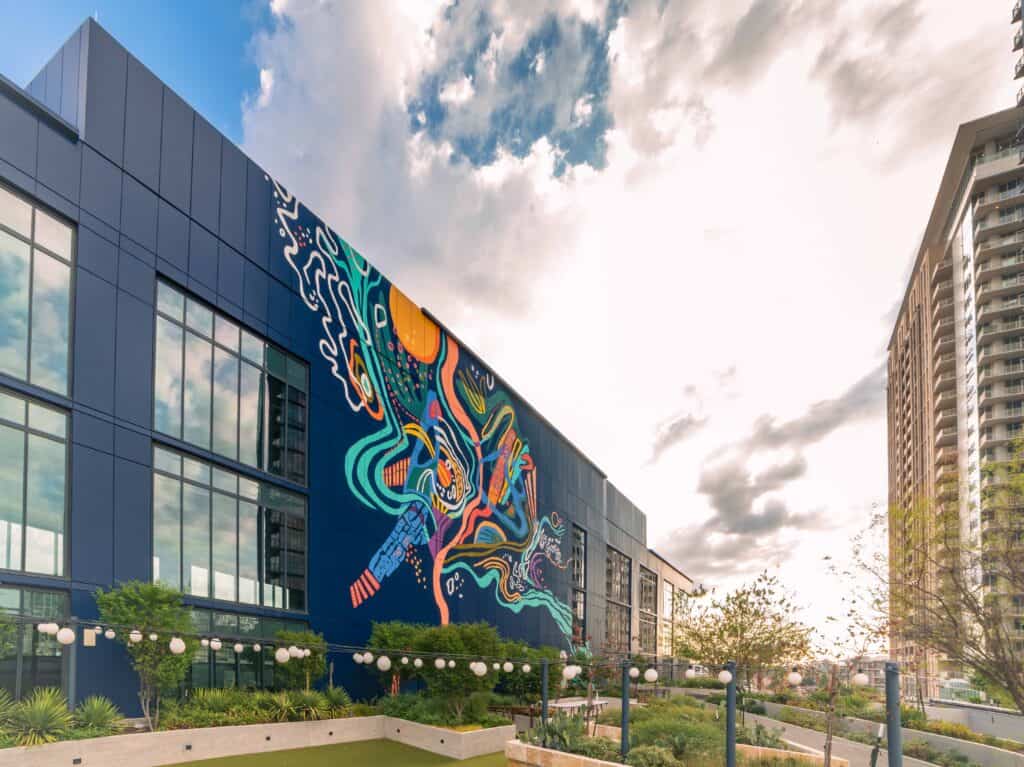
EMILY: If you stand at the corner of 11th and Red River and look north, up five stories, you’ll see my largest mural in Austin, Symphony Square. It’s a tribute to the surrounding area – Waller Creek, the neighborhood’s musical history, and the native flora and fauna – woven together into a single visual language across the building.
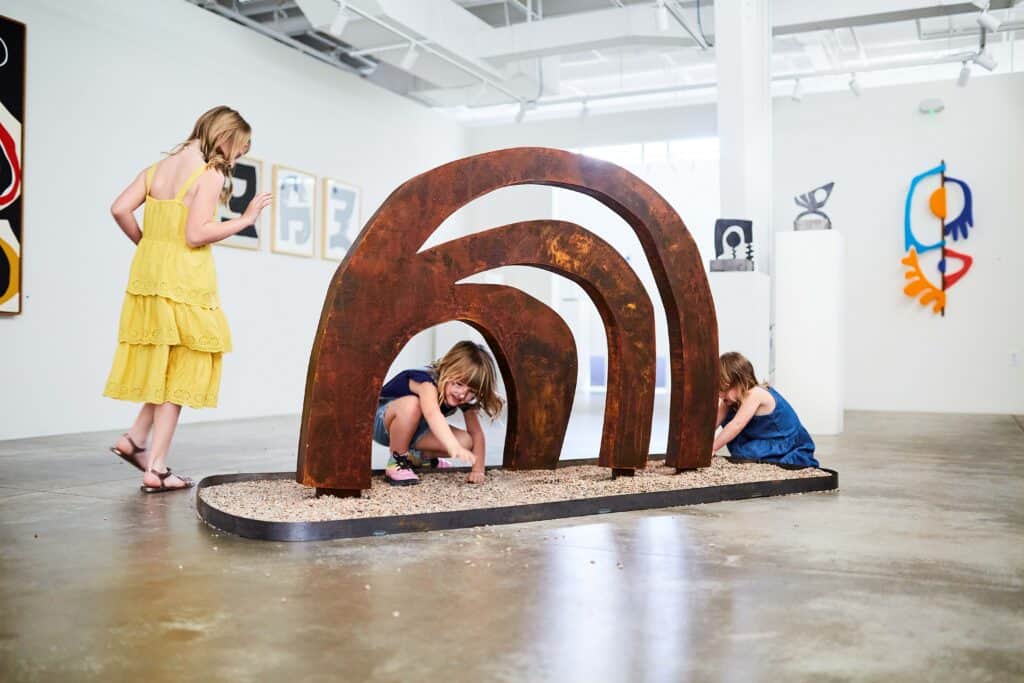
There’s also a sculpture called Echo in the courtyard at Preacher Gallery. It’s a large steel work inspired by abstracted forms of local plant and animal life, with a central portal that invites people to frame their own view of the landscape. It’s been really special to see how people interact with it – kids playing around and beneath it, and adults slowing down and engaging with the space in a more intentional way. The material itself is designed to evolve over time, with raw steel developing a natural patina that ties it more closely to its environment.
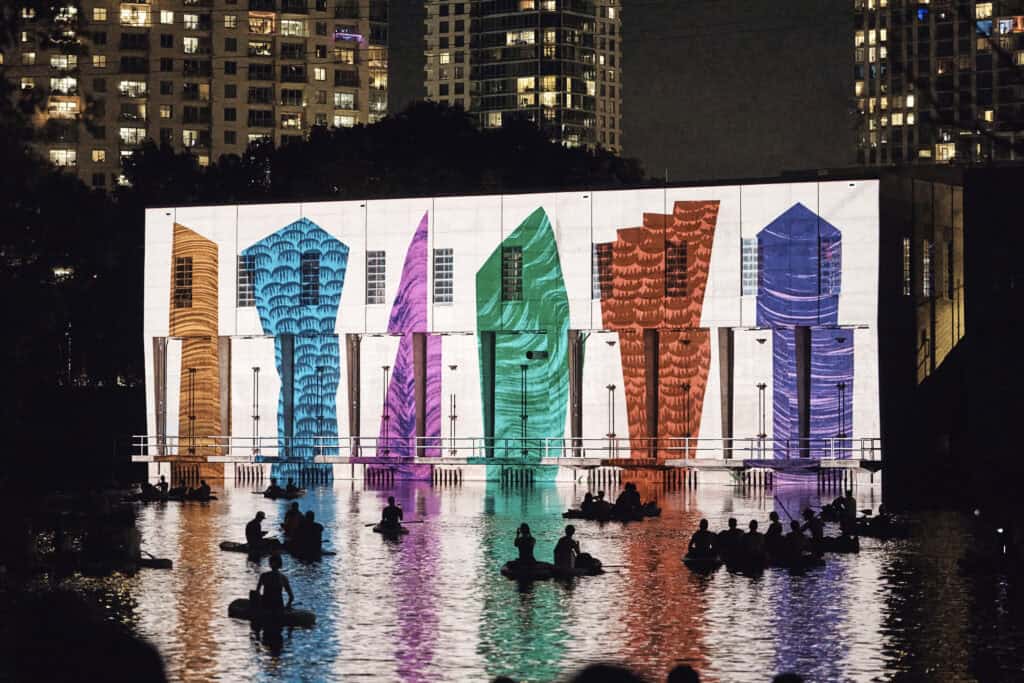
More recently, I conceived and helped produce WaterWork, an immersive projection art show on the historic Seaholm Intake Facility along Lady Bird Lake, in partnership with Design Austin and The Trail Conservancy. Through my studio’s role as co-producer, we bring together a group of local artists to create site-responsive works at a monumental scale. Seeing the work come to life across the water, with audiences experiencing it from the trail, kayaks, and boats, is incredibly powerful. (Also, mark your calendars, September 25-26!).
There are quite a few other pieces scattered around the city as well, in parks, and offices, and even parking garage stairwells…I should really make a map at some point! I love the idea that people can just stumble across my work unexpectedly.
Is there anything else you want to tease ahead of the Spring Garden Party on May 7?
EMILY: Overall, the Spring Garden Party is really about slowing down, being present, and engaging with the landscape in a refreshed way. I’m looking forward to seeing how people make the experience their own. There are a few elements that will really come alive at dusk so I’d encourage people to spend some time with the work as the light changes. It’s designed to be something you move through and experience over time.
I’m also excited to share that I’ve been selected as the artist for a major upcoming sculptural commission at Red Bud Isle through the City of Austin’s Art in Public Places program. It’s a project that continues my exploration of site-specific work rooted in the relationship between art, ecology, and the built environment. It feels like a natural extension of what we’re creating for this event.
Thanks for the chat, Emily!
Learn more about becoming a member of Long Center Collective, and how to RSVP for the Spring Garden Party on May 7.
At the Long Center, we’ve always got a new partnership or something cool we know you’ll want to check out! Find and follow us @longcenter on your social media platform of choice, and we’ll see you real soon.